

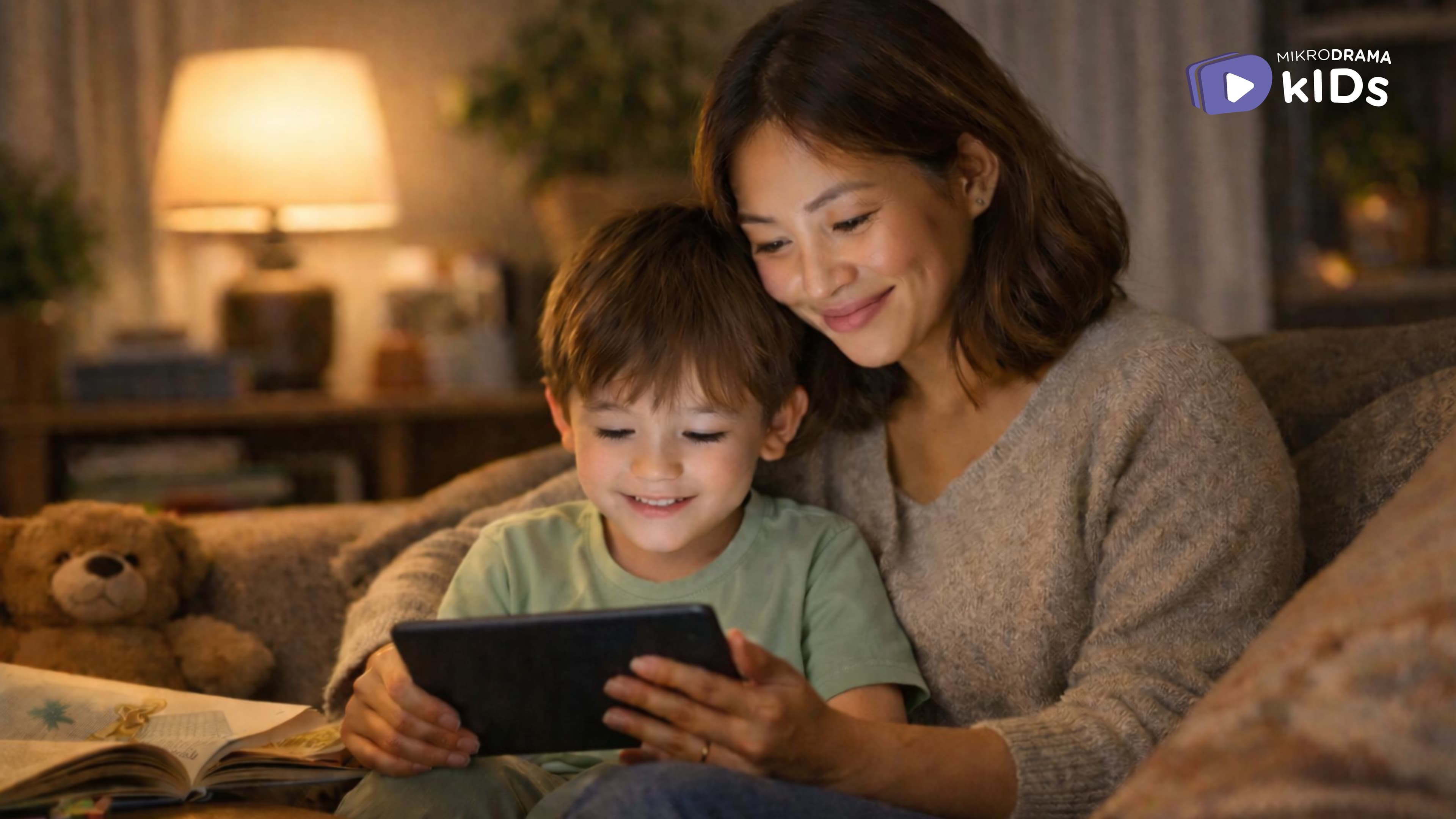
Mikrodrama Kids is being built from scratch to create a safer, more thoughtful digital space for story, learning, discovery, and meaningful participation for children aged 12 and below.
Every day, parents are making small decisions they never had to make before. How much screen time is too much. What is safe. What is helpful. What is harmful. When to allow it. When to say no. In today's world, screens are no longer occasional. They are everywhere, woven into daily life, routines, learning, comfort, and entertainment.
The question is no longer whether children are growing up in a screen and gadget era. They already are. The deeper question is what kind of digital world they are being asked to grow up in, and whether it was ever truly designed with childhood in mind. UNICEF Malaysia captured the pressure many families feel in a simple but powerful way when it said, "Families are overwhelmed."
That is one of the reasons Mikrodrama Kids is being built. Not because children need more content. Not because the world needs another app. But because families deserve something better than the digital choices they are too often left with today.
If screens are already part of childhood, then the question is no longer whether children will grow up with them, but what kind of digital world we are asking them to grow up in.
Childhood Has Changed
Recent findings show just how early and deeply digital life now begins. Common Sense Media reported in February 2025 that 40 percent of children have a tablet by age 2, nearly 1 in 4 have a personal mobile phone by age 8, and children aged 8 and under still spend about 2.5 hours a day on screen media. These are not small behavioural shifts. They are signs that digital life is now becoming part of childhood very early, often before children have the maturity to understand the systems shaping their attention.
The Problem Is Not Just Screens
Yet the answer is not fear. It is not denial. And it is certainly not pretending that digital life can simply be removed from the modern world. UNICEF Malaysia has also stressed that digital platforms can provide opportunities for learning, connection, play, and self-expression, especially for children who may be isolated, marginalised, or living with disabilities. At the same time, it has warned that age restrictions alone will not keep children safe online, and has called for a broader child-rights-based approach to online safety.
That balance matters. The issue is not simply whether children use screens, but what they are exposed to, how those spaces are designed, and whether those experiences support their growth or quietly crowd out what they need most.
Why Mikrodrama Kids Is Being Built From Scratch
We are building Mikrodrama Kids from scratch because childhood should not have to adapt itself to digital environments that were never truly made for children in the first place. Too many digital spaces are shaped by speed, volume, stimulation, endless recommendation loops, fragmented attention, and systems designed to keep people watching for as long as possible. Parents feel this. Caregivers see it. And children absorb it, often before they are old enough to understand it.
That is why child-safe design cannot be an afterthought. It has to be part of the foundation. UNICEF Malaysia's position is especially relevant here, because it argues for systems that protect children online while respecting their rights, dignity, and developmental realities.
Mikrodrama Kids is being created as a child-first digital ecosystem for story, learning, discovery, and meaningful participation for children aged 12 and below. Our aim is not to compete with the loudest corners of the internet. Our aim is to create a calmer, more intentional, more trustworthy kind of digital space, one that respects childhood, supports parents, and offers more than passive entertainment through story-led experiences that encourage imagination, participation, exploration, and age-appropriate learning.
What Children Need More Of
Because the early years of life matter immensely. UNICEF notes that in the first few years of life, more than one million neural connections are formed each second, and that the quality of a child's early experiences shapes the foundations for learning, health, and behaviour throughout life.
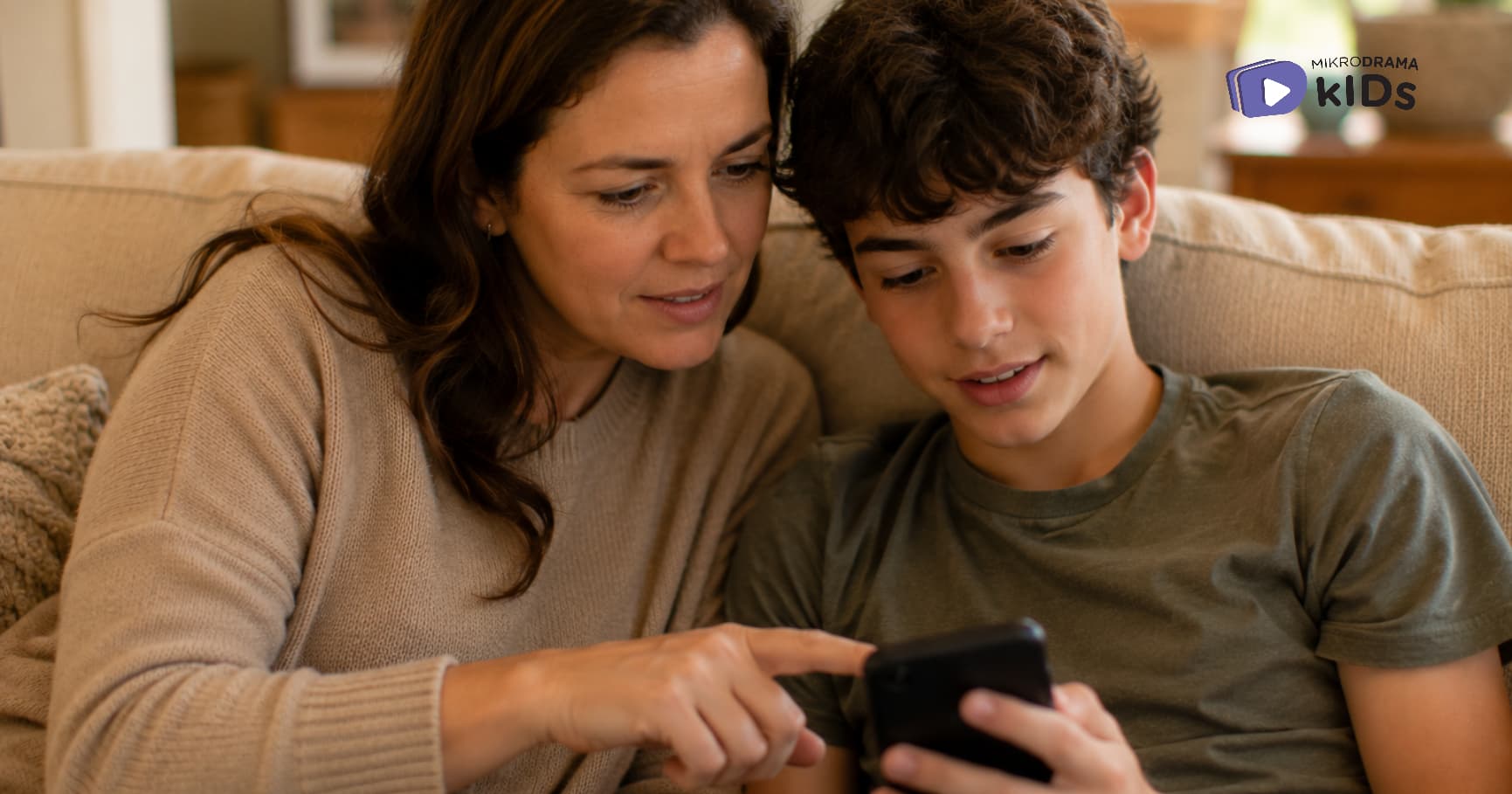
This is also why the conversation about children and screens must move beyond simply counting minutes. The American Academy of Pediatrics now places greater emphasis on quality, context, communication, and family routines, not just quantity alone. Its 2025 guidance says that household rules focused on balance, content, co-viewing, and communication are associated with better well-being outcomes than rules focused only on duration.
HealthyChildren.org, reflecting the same AAP direction, advises parents to seek out "quality content that puts kids first" and to watch and play alongside their children. This thinking is increasingly reflected beyond the United States as well. Singapore's Ministry of Health encourages families to develop healthy screen habits through age-appropriate content, shared engagement, and practical routines, while recent UK guidance highlights the value of responsive parent-child interaction and suitable, slower-paced content for younger children.
The message is becoming clearer across countries: what matters is not only how long children are on screens, but also what they are watching, how they are engaging with it, and whether adults are helping guide the experience.
Why Parents Deserve Better Digital Spaces
We are not building Mikrodrama Kids to encourage children to disappear into screens. We are building it to support more meaningful, age-appropriate, guided, and thoughtful engagement when screens are already part of life. That means moving beyond passive viewing towards story-led experiences that invite participation, reflection, exploration, and gentle learning.
It means interactive story moments, branching choices, playful quizzes, guided responses, co-viewing opportunities with parents and caregivers, and even prompts that encourage children to pause, move, think, create, or complete simple activities beyond the screen.
We believe digital experiences for children should be more intentional, more transparent, more emotionally aware, and far more respectful of the role parents and caregivers play. Parents should not feel like they are handing their child over to a black box. They should feel informed, reassured, and included.
Parents should not feel like they are handing their child over to a black box.
That does not mean concerns are exaggerated. Far from it. Many families worry, with good reason, that open digital platforms expose children too early to inappropriate material, manipulative design, unhealthy comparison, sleep disruption, constant distraction, and a gradual erosion of imaginative depth. Health guidance continues to remind us that children need movement, rest, play, and real human interaction. The World Health Organization has urged that young children should "sit less and play more", and specifically encourages reading and storytelling with a caregiver during sedentary time.

A More Thoughtful Vision for Children's Media
Many of today's parents and caregivers will also remember a very different media rhythm from their own childhood. It was not perfect, but it often moved more slowly. There were pauses. There was anticipation. There were programmes that invited children to listen, sing, think, and absorb.
Many grew up with educational television like Sesame Street, which Sesame Workshop says began with a bold question: could television be used to educate children? It built around a research-based curriculum and went on to change children's television forever. There was something valuable in that slower rhythm, in the waiting, the familiarity, the songs, the spaces between things. Today, much of digital content feels very different. Faster. Denser. Louder. Less patient. And that contrast is part of why this conversation matters so much.
This is why Mikrodrama Kids is being built with a deeper concern in mind. We are not only asking what children are watching. We are also asking how they are engaging, what habits are being formed, and whether digital experiences can encourage more reflection, participation, imagination, discovery, and real-world connection. We are asking whether stories can still be warm, meaningful, imaginative, and safe. We are asking whether technology can be designed with more conscience.
Building With Research, Care, and Intention
As part of that wider effort, Mikrodrama Kids is also currently in research discussions with the National Child Development Research Centre (NCDRC), of Sultan Idris Education University (UPSI), Malaysia. This matters to us because NCDRC's official role includes conducting multidisciplinary research on children aged 0 to 18, as well as collecting and analysing child-related data for research, monitoring, and early detection for future planning. Its broader portfolio also includes training, consultation, outreach, postgraduate study, and child development services.
Our hope is that this research-led direction can help inform a safer, more thoughtful space for children where learning, exploring, and growing up safely are treated with seriousness from the outset.
Why This Matters Now
Our objective is simple to say, even if it takes great care to build. We want to create a digital space where stories are more thoughtful, experiences are more age-appropriate, parents feel more confident, and children are invited not just to watch, but to participate, imagine, respond, explore, and learn in ways that feel natural and enjoyable. We want to support curiosity, reflection, discovery, co-viewing, and healthier habits rather than constant overload.
This is not about claiming perfection. It is not about pretending one platform can solve every challenge families face in the screen era. It is about recognising that children deserve better digital spaces, and that parents deserve better support than they are often given. If screens are already part of childhood, then surely the next step is to build digital environments that are more worthy of children, not simply more addictive for them.
That is the heart behind Mikrodrama Kids.
It is being built because childhood matters. Because parents matter. Because story matters. Because design matters. And because in a world where so much digital content competes for attention, there is still room, and a growing need, for something built with greater care from the very beginning.
We hope Mikrodrama Kids can become part of that better direction. Not as a replacement for parenting, play, conversation, rest, or real life, but as a more thoughtful companion within the digital world children already inhabit. A place shaped not only by technology, but by concern. Not only by content, but by conscience. Not only by what children can watch, but by what kind of childhood we are helping protect.
At Mikrodrama Kids, we believe childhood deserves more thoughtful digital spaces. If you are a parent, caregiver, educator, or partner who shares that belief, we invite you to follow our journey as we work to build something better for the next generation.
References and Sources
1. UNICEF Malaysia. "Age Restrictions Alone Won't Keep Children Safe Online, Says UNICEF." Press release. 15 December 2025. UNICEF Malaysia.
2. UNICEF. "Early Childhood Development." UNICEF. Accessed 18 April 2026.
3. World Health Organization. "To Grow Up Healthy, Children Need to Sit Less and Play More." News release. 24 April 2019. World Health Organization.
4. American Academy of Pediatrics. "Screen Time Guidelines." 22 May 2025. American Academy of Pediatrics.
5. HealthyChildren.org. "Helping Kids Thrive in a Digital World: AAP Policy Explained." Last updated 20 January 2026. American Academy of Pediatrics Council on Communications and Media.
6. Common Sense Media. "The 2025 Common Sense Census: Media Use by Kids Zero to Eight." 26 February 2025. Common Sense Media.
7. Adams, Carin, Laura Kubin, and John Humphrey. "Screen Technology Exposure and Infant Cognitive Development: A Scoping Review." Journal of Pediatric Nursing 69, March to April 2023, e97 to e104. DOI: 10.1016/j.pedn.2022.12.013.
8. Tan, Cheng Yong, Naiqi Xu, Mengyi Liang, and Li Li. "Meta-analysis of Associations Between Digital Parenting and Children's Digital Wellbeing." Educational Research Review 48, August 2025, 100699. DOI: 10.1016/j.edurev.2025.100699.
9. Sesame Workshop. "Shows." Sesame Workshop. Accessed 18 April 2026.
10. National Child Development Research Centre, Sultan Idris Education University. "NCDRC English Portal." NCDRC, UPSI. Accessed 18 April 2026.
11. Ministry of Health Singapore. "Guidance on Screen Use in Children." 21 January 2025. Ministry of Health Singapore.
12. UK Government. "New Screen Time Guidance for Parents of Under-5s." 26 March 2026. Department for Education and Department of Health and Social Care.
13. UK Government. "Screen Use by Children Aged Under Five: Independent Report." 27 March 2026. UK Government.
Found this helpful?
This article is intended for general informational and educational purposes only. Please read our Blog Disclaimer.
.jpg&w=3840&q=75)

.jpg&w=3840&q=75)