

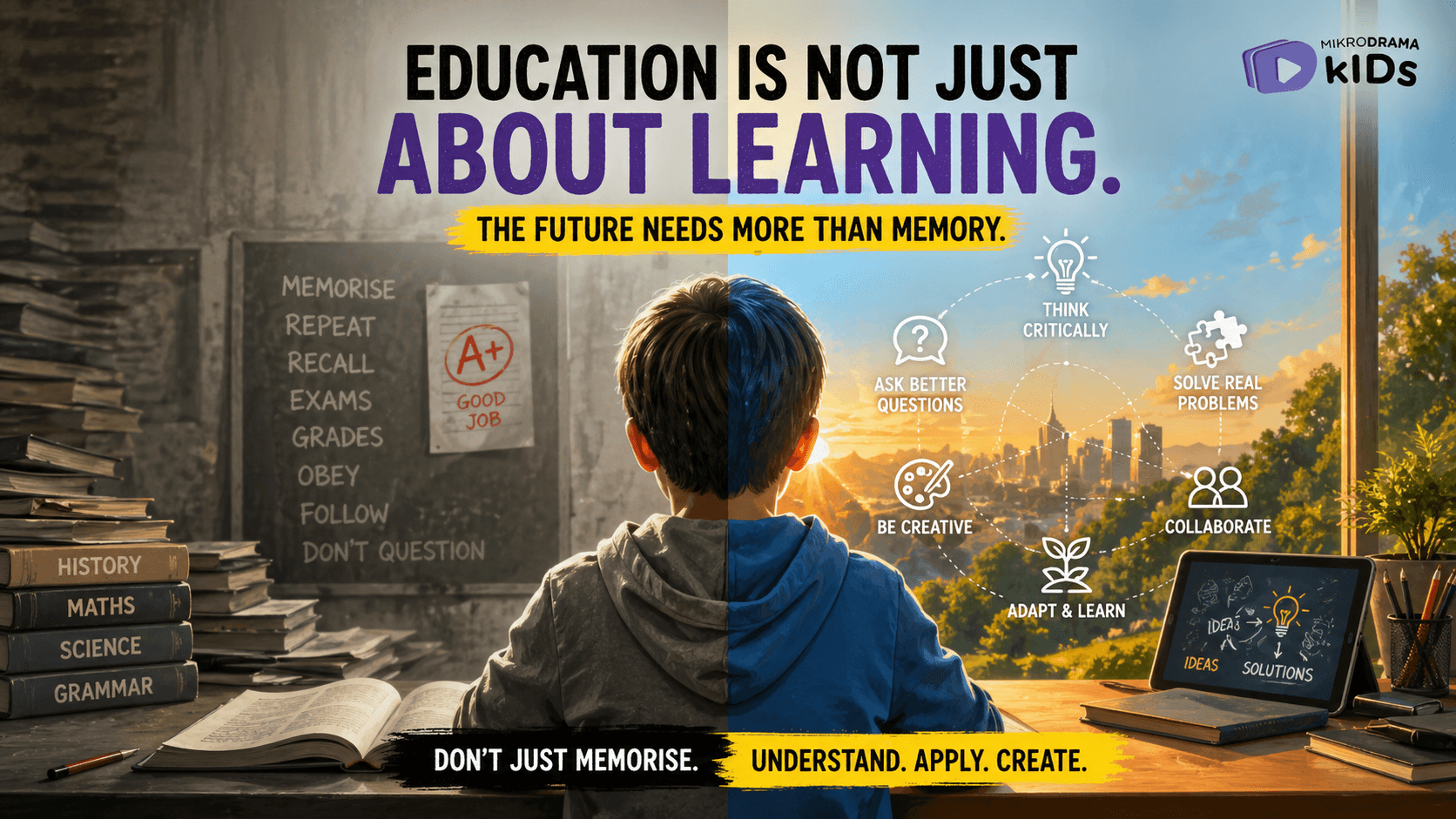
We have long treated memory as intelligence. But as AI reshapes the world, the real question is no longer whether children can remember answers — it's whether they can think, judge, and understand.
For a very long time, we have treated memory as if it were intelligence.
The student who could remember the most facts, repeat the most definitions, and reproduce the cleanest answers was often seen as the smartest person in the room. Schools rewarded it. Exams depended on it. Parents admired it. Entire systems were built around it.
But the world has changed.
And whether we are ready to admit it or not, a large part of what we still call education is becoming dangerously outdated.
This does not mean learning is useless. It does not mean education has no future. It means we may have misunderstood what education was supposed to do in the first place.
Because education is not just about learning facts.
And intelligence is not just about remembering them.
When Information Was Scarce
For decades, memory had practical value because information was scarce. If you knew something, that mattered. If you could recall it quickly, that gave you an advantage. Knowledge had to be stored in the mind because it was not always available in the moment. Books were limited. Experts were fewer. Answers were harder to find.
Now, we live in a world where information is everywhere.
A child can search for an answer in seconds. An adult can ask AI to summarise a complex topic instantly. A worker can generate a report, a strategy, a draft, or a solution with tools that did not exist a few years ago.
So the question is no longer: Can you remember the answer?
The real question is: Do you understand what the answer means?
And even more importantly: Can you judge whether it is right, useful, ethical, relevant, and complete?
That is a very different kind of intelligence.
Where Education Is Falling Behind
The future will not reward people simply for storing more information in their heads. It will reward people who can think clearly, question deeply, connect ideas, spot flaws, adapt quickly, and use powerful tools without becoming dependent on them.
That is where many education systems are now falling behind.
Too much of modern schooling still revolves around memorisation, repetition, compliance, and answer retrieval. Students are often trained to perform well in structured systems rather than think well in messy reality. They are taught to fear mistakes instead of investigate them. They are pushed to chase correct answers instead of learning how to ask better questions.
And that is becoming a serious problem.
Because in the coming years, AI will continue to shrink the value of pure recall. It will write, summarise, explain, compare, calculate, and retrieve faster than most humans ever could. If our definition of intelligence is based only on information recall, then machines will win that contest easily.
But that is exactly why we need to rethink what human intelligence really is.
What Human Intelligence Actually Is
Human intelligence is not just memory.
It is judgment.
It is imagination.
It is interpretation.
It is emotional awareness.
It is taste. It is context. It is restraint.
It is the ability to make sense of ambiguity when there is no obvious answer.
It is the ability to look at two similar ideas and notice what everyone else missed.
It is the ability to ask, “Should we?” — not just “Can we?”
That is what education should have been building all along.
The Children Who Will Thrive
The children who will thrive in the future are not necessarily the ones who memorise the most. They may be the ones who learn how to think independently while using technology wisely. The ones who know how to sit with uncertainty. The ones who can solve unfamiliar problems. The ones who can communicate clearly, collaborate with others, challenge assumptions, and hold on to their humanity in a world increasingly shaped by machines.
In that kind of future, memory still matters. But it is no longer enough.
We do still need knowledge. We still need foundations. We still need children to read, write, count, understand history, and grasp the basics of science, language, and the world around them. But that foundation should not be mistaken for the final goal.
The Real Goal of Education
The goal of education cannot simply be information storage.
It must be wisdom-building. Character-building. Judgment-building.
It must teach people how to learn, how to think, how to discern, how to create, and how to remain intellectually alive in a world where answers are cheap but understanding is rare.
That is the real shift now underway.
The danger is not that children will stop learning. The danger is that they will keep learning in ways that no longer prepare them for the world they are entering.
If we continue to train children to memorise what machines can retrieve, we may produce high-scoring students who are deeply unprepared for real life. People who can pass tests but cannot navigate complexity. People who can repeat information but cannot evaluate it. People who can generate output but do not truly understand what they are doing.
That is not education at its best.
That is training for irrelevance.
The next five to ten years will not make education useless. But they may expose just how much of our current model was built on the wrong assumptions.
We thought memory was intelligence. We thought recall was mastery. We thought repeating information meant understanding it.
It does not.
The future will belong to those who can do more than remember.
It will belong to those who can think.
Found this helpful?
This article is intended for general informational and educational purposes only. Please read our Blog Disclaimer.
.jpg&w=3840&q=75)


.jpg&w=3840&q=75)