

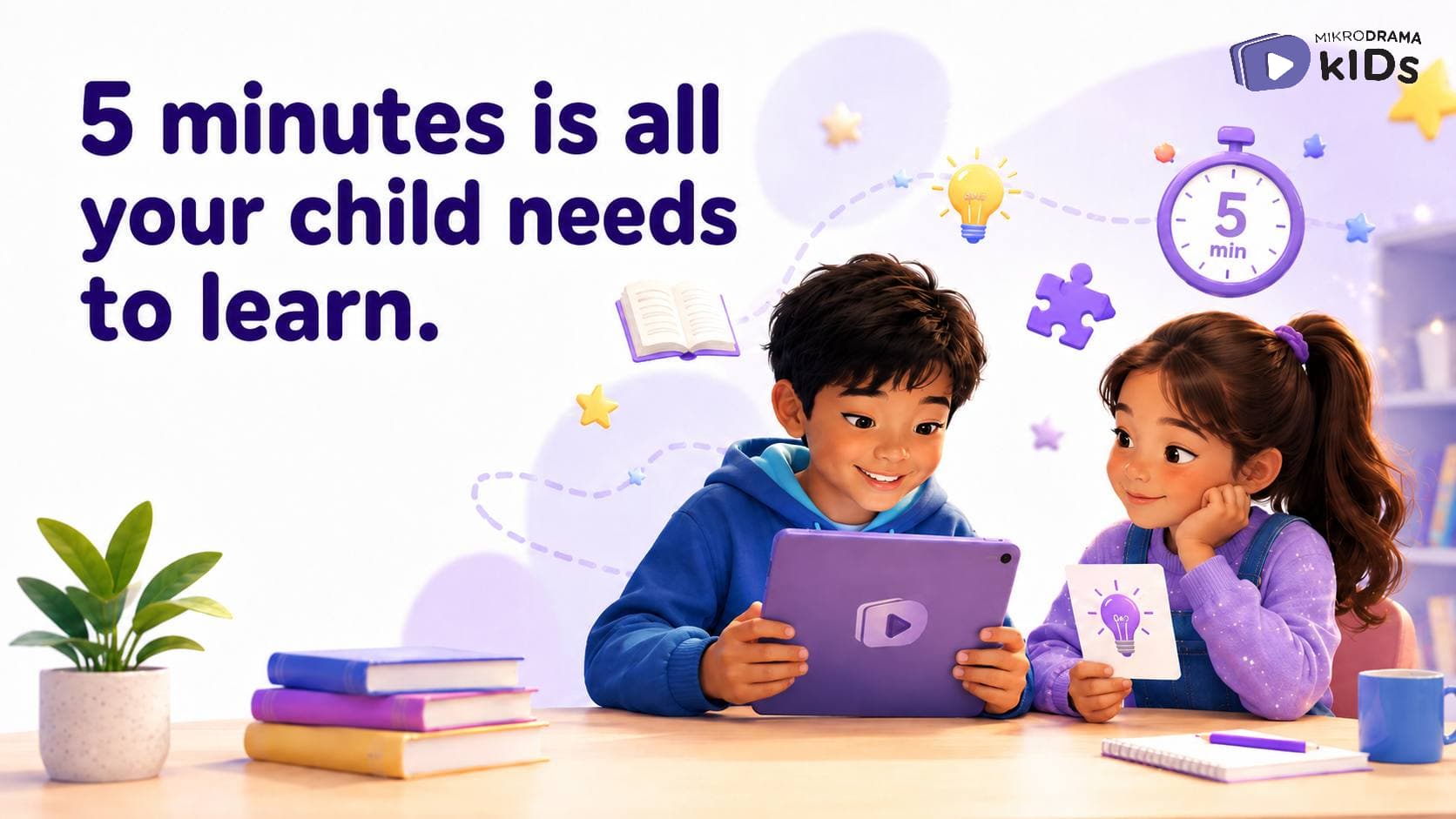
We've been told that kids have no attention span. But the real problem isn't their brains, it's the 45-minute lessons we keep giving them. Research suggests a 7 year-old can genuinely focus for about 14–21 minutes. Micro-learning respects that limit. Short bursts under 10 minutes reduce cognitive load, increase completion rates, and improve retention. And when you add a story? A five-minute narrative activates memory, emotion, and active thinking. This post breaks down the science of short attention spans and gives parents four practical tips to turn screen time into learning time.
Why 5 Minutes is All Your Child Needs to Learn (The Science of Short Attention Spans)
The Attention Span Myth
You've heard it before: "Kids these days have no attention span."
But here's what most people get wrong. A child's attention span isn't broken. It's just different.
Research suggests that a child's focused attention lasts roughly 2 to 3 minutes per year of age. That means a 7-year-old can genuinely focus for about 14–21 minutes. A 10-year-old? 20–30 minutes.
The problem isn't that children can't focus. The problem is that we keep giving them 45-minute lessons, hour-long documentaries, and homework blocks that ignore how their brains actually work.
Enter micro-learning.
What is Micro-Learning?
Micro-learning is exactly what it sounds like: learning in small, focused bursts. Usually under 10 minutes. Often under 5 minutes.
It's not about dumbing down content. It's about respecting the brain's natural limits.
When information is delivered in short chunks:
- Cognitive load decreases – The brain doesn't get tired as quickly
- Completion rates go up – Children actually finish what they start
- Retention improves – Less information per session means more sticks
- Anxiety drops – A 5-minute task feels achievable. A 45-minute task feels overwhelming.
Why Stories Make Micro-Learning Work
Here's the secret ingredient. Micro-learning alone isn't magic. What makes it work is narrative.
A 5-minute list of facts is still boring. But a 5-minute story with a beginning, middle, and end? That's different.
When children watch a short story:
- Their brain releases oxytocin (the "bonding and memory" chemical)
- They predict what happens next (active thinking, not passive watching)
- They connect emotionally to the character (which anchors the information)
A 5-minute story about a girl who loses her dog and uses a map to find her? That child just learned map reading, problem-solving, and emotional regulation. All in one short sitting.
Practical Tips for Parents
You don't need a special curriculum. You just need to change how your child watches.
Tip 1: Set a timer, not a clock.
Instead of "you can watch until dinner," say "you can watch two 5-minute episodes." Finite is easier for a child's brain to manage.
Tip 2: Watch the first episode together.
Ask one question afterward: "What did the character learn?" That single question turns passive watching into active learning.
Tip 3: Use micro-learning as a preview.
Before a school unit (say, volcanoes or fractions), find a 5-minute educational video. Your child walks into class already confident.
Tip 4: Respect the stop.
When the 5 minutes are over, stop. Even if they beg for more. Ending on a high note builds anticipation for next time.
The Bottom Line
Longer is not better. Louder is not better. Faster is not better.
For a child's developing brain, shorter is smarter.
Five minutes of a well-structured story beats 30 minutes of chaotic scrolling every single time.
So next time you have a choice between a 45-minute documentary and a 5-minute story? Go small. Your child's brain will thank you.
About This Blog
This article is part of our parenting resource series. We provide evidence-based guidance on children's media, learning, and development for families with children ages 0–12.
Found this helpful?
This article is intended for general informational and educational purposes only. Please read our Blog Disclaimer.
.jpg&w=3840&q=75)

.jpg&w=3840&q=75)