

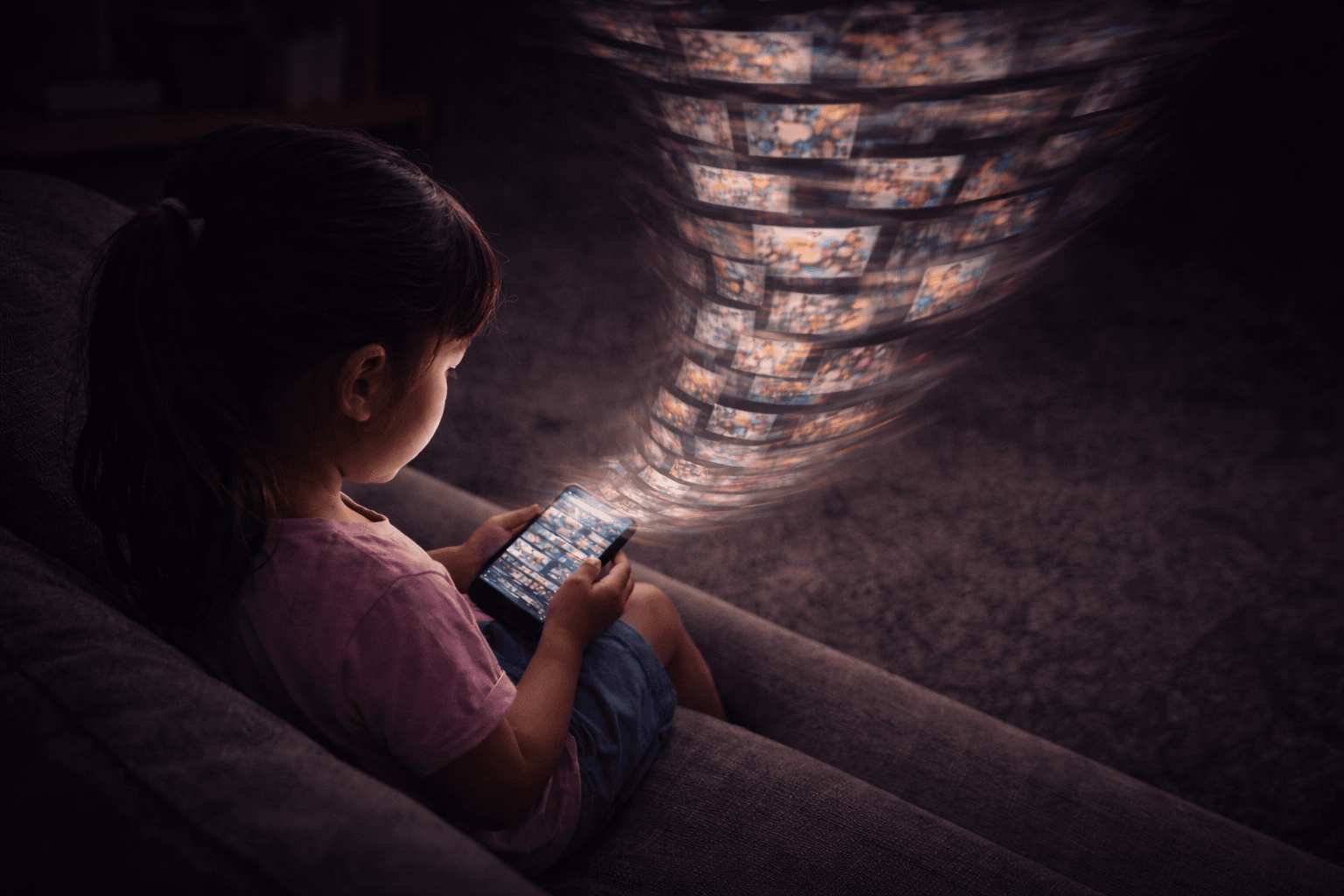
Why the design of a platform can shape behaviour just as much as the content itself
Many parents think the main concern is how long a child spends on a screen.
But in many homes, the deeper issue is something else entirely.
It is the way the experience is designed.
A child can watch one meaningful story, finish it, and move on with their day. Or a child can enter a digital environment where the next video appears almost instantly, where there is always something else to tap, and where stopping begins to feel less natural than continuing.
That difference matters more than many people realise.
The Problem Is Not Only Content
Parents often focus on whether a video is educational, harmless, or age appropriate.
Those things matter.
But even seemingly harmless content can become part of an unhealthy experience when it is delivered through a system designed to keep children moving endlessly from one piece of content to the next.
This is where infinite scroll changes the picture.
When a platform removes natural stopping points, it does more than extend viewing time. It begins to teach children a rhythm of constant continuation. One more video. One more tap. One more recommendation. One more distraction.
The lesson is subtle, but powerful.
It teaches that there is always more.
It teaches that stopping feels unnatural.
It teaches that attention should keep moving.
It teaches that quiet endings are less rewarding than constant stimulation.
What Children Need Instead
Childhood depends on rhythm.
Children need pauses. They need transition. They need time to finish one thing before being pulled into another. They need space for imagination, conversation, boredom, movement, and rest.
These moments may look small, but they are part of healthy development.
A pause after a story gives a child space to think.
A stopping point gives a parent room to speak.
A finished episode makes it easier to move into play, reading, mealtime, bath time, or sleep.
When those pauses disappear, the experience begins to shape behaviour in ways that can spill into the rest of family life.
What Parents Often Start to Notice
Most parents do not describe it by saying, “This platform is conditioning my child to expect constant stimulation.”
They describe what happens at home.
My child gets upset when it is time to stop.
One short viewing session turns into a much longer one.
They seem restless afterwards, not settled.
They ask for the device almost automatically.
It becomes harder to transition into bedtime, homework, meals, or play.
These everyday struggles often reflect more than content preference. They reflect design. When children become used to environments that keep offering the next thing without pause, stopping starts to feel like loss rather than completion.
That is a very different experience from watching one story, ending it, and carrying on with the day.
Why This Matters More Than Ever
Many digital experiences today are not simply libraries of content. They are systems built around attention.
For adults, this is already difficult enough.
For children, it is even more important to think carefully about what kind of habits are being formed. A child does not only absorb the story on screen. A child also absorbs the pattern around it.
If the pattern is endless continuation, that pattern becomes familiar.
If the pattern is calm viewing with natural boundaries, that becomes familiar too.
In other words, platforms do not only deliver content.
They also teach tempo.
And tempo matters.
Fast, endless, highly stimulating experiences can make slower real life activities feel less appealing by comparison. Reading, drawing, building, waiting, listening, or simply sitting quietly may begin to feel less satisfying for a child who is becoming used to constant digital movement.
This does not mean every child who enjoys a tablet is in danger.
It simply means parents are right to look beyond the surface and ask deeper questions about what the experience is training a child to expect.
A Better Question for Parents
Instead of only asking, “Is this video okay?”
It may help to ask, “What kind of viewing habit is this platform encouraging?”
Does it allow for endings?
Does it respect a child’s pace?
Does it support boundaries, or quietly work against them?
Does it create room for real life after the screen is turned off?
These questions shift the conversation from passive content approval to thoughtful digital parenting.
And that shift matters.
Because children do not just need safer content.
They need healthier digital environments.
What a Better Experience Can Look Like
A better digital experience for children is not one that demands attention for as long as possible.
It is one that knows when to stop.
It feels intentional rather than endless.
It offers stories, not traps.
It encourages curiosity without turning every moment into a chase for more.
And most importantly, it leaves room for everything that childhood still needs beyond the screen.
A better experience helps the child return to life.
To books.
To crayons.
To garden walks.
To questions.
To cuddles.
To sleep.
To boredom.
To imaginative play.
To the real world.
How Mikrodrama Kids Sees It
At Mikrodrama Kids, we believe children deserve more than platforms built around endless continuation.
We believe a children’s platform should feel thoughtful, curated, and respectful of childhood.
It should not be designed to keep children in a loop for as long as possible.
It should be designed to support balance, calm viewing, and healthy boundaries.
Because the future of children’s media should not only be about what children can watch.
It should also be about what kind of habits the platform is helping to create.
That is why the conversation around children and screens can no longer stop at content alone.
Design matters too.
And when we design better, we give children something far more valuable than endless entertainment.
We give them space to remain children.
Found this helpful?
This article is intended for general informational and educational purposes only. Please read our Blog Disclaimer.
.jpg&w=3840&q=75)

.jpg&w=3840&q=75)