

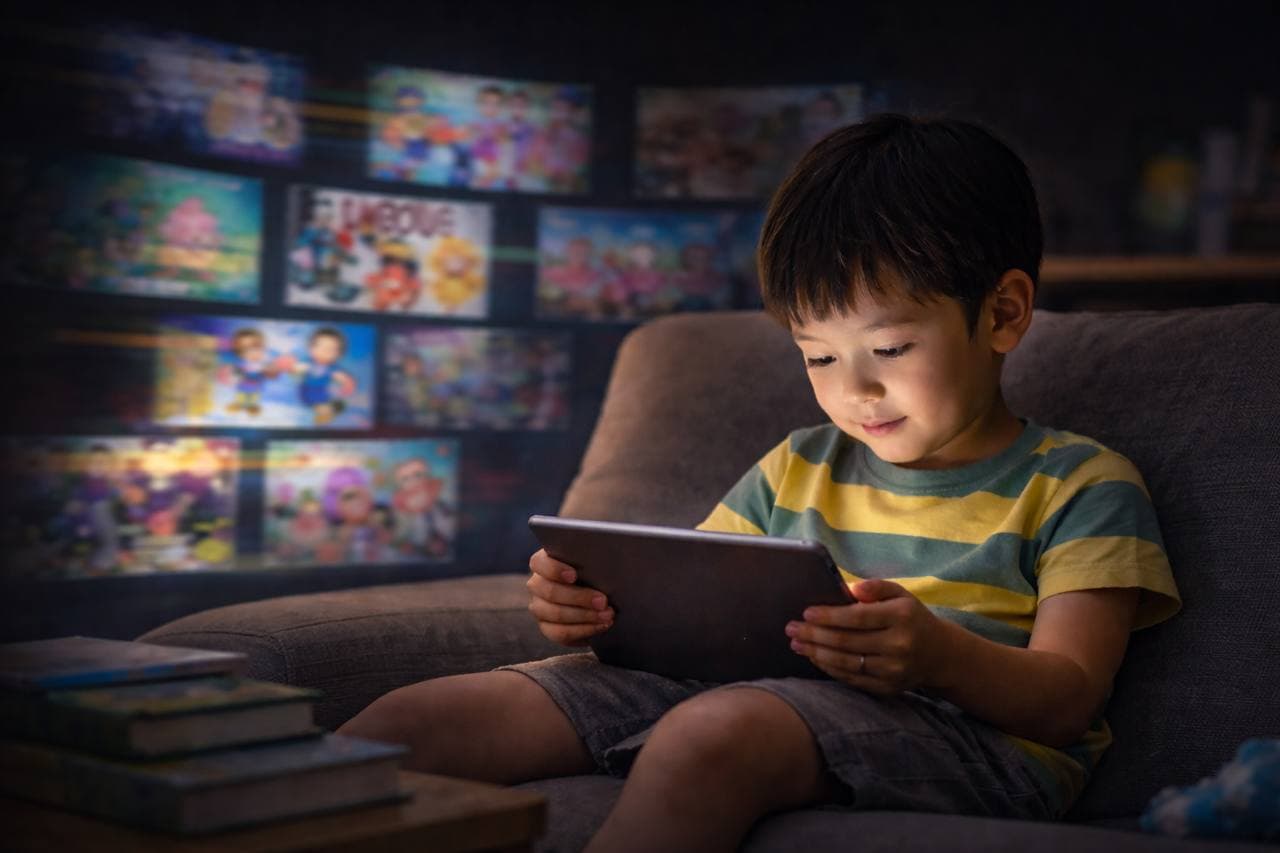
What parents and caregivers should really be looking at in today's digital world — because the quality of screen time matters just as much as the quantity.
What parents and caregivers should really be looking at in today’s digital world.
The question every parent is asking
For years, many parents have been asking the same question: how much screen time is too much?
It is a fair question. Devices are now part of daily life, and for many families they are impossible to avoid entirely. Screens are used for learning, entertainment, communication, and sometimes simply to get through a busy day. But the conversation around children and screens has also become more complex, and the answer is no longer as simple as counting minutes alone.
What matters just as much, and often more, is the quality of the experience.
Not all screen time is equal
A child watching one calm, age appropriate story with a parent nearby is not having the same experience as a child moving through an endless stream of fast, autoplaying content designed to keep them watching. The screen may be the same. The outcome may not be.
Recent guidance from the American Academy of Pediatrics has moved away from one fixed universal time limit for all children and instead encourages families to look at the full picture, including content, context, routines, and how media affects sleep, relationships, and everyday life.
Childhood needs more than entertainment
Children need conversation, movement, play, boredom, imagination, sleep, and time with the people around them. For younger children especially, global health guidance continues to stress that screen based sedentary time should not crowd out physically active play, healthy sleep, and caregiver interaction.
The World Health Organization advises that for one year olds, sedentary screen time is not recommended, and for two year olds it should be no more than one hour, with less being better.
What parents notice first
What many parents notice first is not always “too much screen time” in the abstract. It is what starts to happen around it.
A child may become more upset when asked to stop. Bedtime may become harder. Offline play may feel less appealing. Quiet moments may suddenly need to be filled. The issue is not always the presence of a device itself. Often, it is the way certain digital experiences are built to remove stopping points, reduce reflection, and keep attention moving from one piece of content to the next.
Public health research continues to associate heavier screen use with behaviours such as later bedtimes, shorter sleep, poorer sleep quality, and daytime tiredness.
Safe content is not enough — safe design matters too
That is why parents today need more than simple rules. They need better distinctions.
Not all content that looks child friendly is truly child centred. Bright colours, catchy sounds, and familiar characters do not automatically mean an experience is healthy, developmentally thoughtful, or emotionally appropriate. Safe content matters, but so does safe design.
UNICEF Malaysia has recently argued that protecting children online cannot rely on age restrictions alone and that stronger platform responsibility and age appropriate design are also essential.
Better questions to ask
In practical terms, this means parents may want to start asking a different set of questions — ones that go beyond the clock.
- Does this content have a natural beginning and end?
- Does it encourage calm attention or constant stimulation?
- Can my child stop without distress?
- Does it leave room for conversation, reflection, and real life activity afterwards?
- Is the platform helping my family, or is it quietly working against the boundaries I am trying to build?
These questions are often more useful than minutes alone, because they focus on the lived experience of the child rather than just the clock. That is also consistent with the broader direction of current paediatric guidance, which emphasises family routines, content quality, and the overall effect of media use on wellbeing.
The future of children’s media
Children do not need platforms designed to pull them endlessly forward. They need digital spaces that respect rhythm, rest, curiosity, and learning. They need stories that can end. They need room to return to drawing, building, talking, moving, resting, and simply being children.
They need digital experiences that support development rather than compete with it. That broader balance is reflected in international guidance that links healthy development to active play, good sleep, and reduced sedentary screen exposure.
Our belief at Mikrodrama Kids
At Mikrodrama Kids, this belief sits at the heart of how we think about children’s media.
We believe better content alone is not enough. Better design matters too. A children’s platform should not simply be a smaller version of the wider digital world. It should be more thoughtful, more curated, and more respectful of childhood itself. It should help parents feel more confident, not more overwhelmed. It should give children something meaningful to watch, while also leaving space for life beyond the screen.
Because in the end, the goal is not to make children stay longer.
The goal is to give them something better.
Found this helpful?
This article is intended for general informational and educational purposes only. Please read our Blog Disclaimer.
.jpg&w=3840&q=75)

.jpg&w=3840&q=75)